| home |
SDS-Website
The Leader
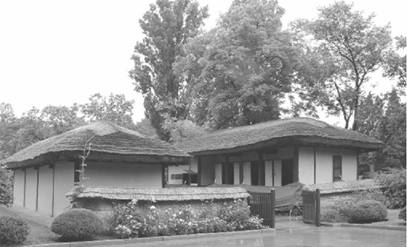
Mangyongdae, birthplace of the Leader
On April 15th
the birthday of the Leader is celebrated throughout the whole country.
According to the
official version, Kim Il-Sung was born on this date in the year 1912 at
Mangyongdae, a little hamlet west of Pyongyang on the Taedong River, the
big river in the north of Korea. Every visitor from abroad is led to his
birthplace; North Koreans see it at least once in their lifetime. The
other houses of the hamlet were torn down and the surroundings of the
birthplace converted into a park. This house is one of the relics in the
foundation-myth of the state. From dawn to dusk, the whole year round,
troops of visitors arrive --from kindergarten children to factory
corps-- to be guided in goose-step through the national sanctuary. The
march-columns, many of which have been driven here in buses or on
trucks, wait in a disciplined manner until it is their turn to pass
--sightseeing-- in review. Following this, one goes to a nearby museum,
where the history of the revolutionary family and the Leader's
revolutionary childhood are shown in pictures and texts. Thus goes the
official version:
Mangyongdae is the cradle of the Korean Revolution. Mangyongdae is as
dear to each Korean as his own birthplace. Here was born comrade Kim
Il-Sung, the Leader of the forty million Koreans (North and South
Koreans together), the incomparable patriot, the national hero, the
always-through-his-iron-will-victorious-and-excelling Leader, and one of
the outstanding Leaders of the international communist and workers'
movement. And here he spent his childhood. Today our people in the
socialist fatherland lead an infinitely happy life, which will become
ever happier under the sunlight which emanates from the great Leader,
who has always led the Korean revolution to victory and glory, by taking
upon himself the fate of the fatherland and the nation.
In the park surrounding the birthplace the visitor is also directed to
other remarkable sites of worship. There is, for example, the tree that
little Kim Il-Sung is supposed to have climbed, thus revealing at such
an early age his high aspirations. Or the "war-rock" is pointed out, a
boulder on which young Kim Il-Sung had played soldiers with his friends
and cried out: "Throw the Japanese out of Korea." Kim Il-Sung spent the
first four years of his childhood in this hamlet.
Kim Il-Sung, it is
true, is celebrated as the founding hero of the state, to whom the
Korean people are said to owe everything and with whom the true history
of the people is supposed to have begun; but his father and his mother,
both of them descending from progressive, patriotic families, are also
tied into this history and constitute, so to speak, the elements of its
pre-history. The whole family is venerated as a holy family. So the
father, Kim Hyong-Jik, who was a teacher by profession, is introduced as
a nationalistic freedom-fighter, who was arrested in 1917, fled to
Manchuria in 1918, and is said to have started a school there for the
daughters of poor farmers. The mother, Kang Ban-Sok (in Korea the women
keep their maiden names after marrying), the model of the Korean woman,
supported her husband and her son in their revolutionary work. She is
said to be the mother of Korea.
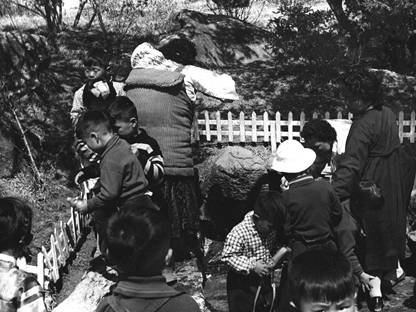
Holy Leader-Water at Bonghwa-Ri
Bongwha Ri is
another national relic and stage of the myth with which the visitor is
confronted. It is a village at some greater distance from Pyongyang,
where the family moved in 1916 when the father, Kim Hyong-Jik, got a
position there as a teacher. The school building and the house they
lived in are the centers of attraction for Korean pilgrims. Here
particularly the father is extolled as a revolutionary teacher. Here the
father implanted patriotic views in his son and in the farmers, and
organized the national resistance against the Japanese. Here clandestine
meetings took place on mountains and under trees, and in 1917 the father
was arrested at this place. Worth mentioning in this connection is a
spring from which the family fetched water. Every Korean visiting this
national shrine today goes to this spring to drink the water from which
the Leader drew his strength. Many of them bring along special vessels
to take some of this miraculous water home.
Such sanctuaries in
connection with the foundation-myth, places where the Leader made
exceptional decisions, fought important battles or founded something,
are numerous in the People's Republic of Korea. Among the most important
of them is Mt. Paek-tu-san on the border with China. Here the Leader in
1936 founded the "League for the National Rebirth of the Fatherland" and
established a few guerrilla camps during the anti-Japanese struggle.
This snow-covered mountain (Paektu-san means "white-head-peak") is not
only a destination for national pilgrimages but, above all, the symbol
of the foundation of the nation. It is interesting to note that also the
last imperial dynasty of China, the Manchu, traced back its origin to
this mountain. A magpie is said to have brought a red-colored fruit to a
white-clad maiden on the shore of lake Bôlhuri; the girl ate it and
consequently gave birth to the first Manchu prince. Here it is important
to know that the myth of origin of the People's Republic of Korea in
many ways leans heavily in its construction upon old models. But the
Manchurian myth, expressing the act of procreation in its sexual
symbolism, is sheer materialism compared with the helpless farce of the
myth about the hero, Kim Il-Sung. Every classical myth expresses the
collective experiences of a people, i.e., of its civilizational process.
The myth of Kim Il-Sung is a mere instrument of power.
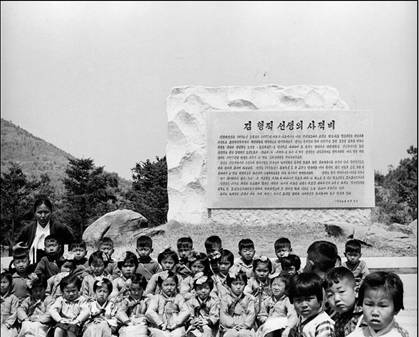
A Kindergarten visiting Bongwa-Ri
As a last important
example of the places of national cult Bochonbo must be mentioned. This
place is also situated on the Korean-Chinese border. Here, on June 4,
1937, the victorious battle against Japanese troops took place
representing the final liberation of the country from Japanese
occupation. Strictly speaking, there is a difficulty in constructing the
myth of having the country liberated by its hero. Kim Il-Sung, if we
follow the official history, left Korea at the age of fourteen saying he
didn’t wish to return to his home country until it was free.
Consequently, he stayed in Manchuria from 1926 on, and only in 1945,
with the Soviet troops, returned to Korea. The strong emphasis on the
battle at Bochonbo (this place at least lies in Korean territory) is
supposed to bridge over this difficulty. Except for this incident, Kim
Il-Sung directed the struggle for freedom against the Japanese
occupation only from abroad --this also according to the official
version. That’s why also Bochonbo has been turned into a shrine for
veneration. A gigantic monument, 78 meters in length and 48 meters in
height, in the manner of socialist realism, Stalinist-style, has been
put up to glorify the heroes of the national struggle for liberation.
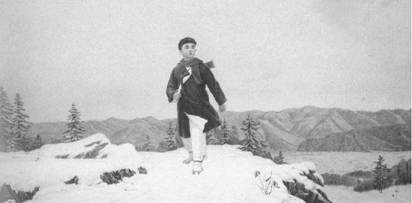
The future Leader leaves his native place
In the People's
Republic of Korea art, in the genre of socialist realism, is supposed to
help overcome the difficulty of documenting Kim Il-Sung's role in the
liberation of the Korean people from Japanese imperialism. Except for
two or three strongly retouched pictures, there are no photos showing
Kim Il-Sung as a partisan like Fidel Castro, Che Guevara or Mao Zedong.
All the "documents" showing Kim Il-Sung in the guerilla camp, with
weapons or without them, explaining future tactics to a group of
partisans as Leader of the guerrillas, are art products from the
workshops of illustrators of the national myth. Examining the products
of art in the People's Republic of Korea, one can say that it is the
task of socialist realism to illustrate the national myth.
Besides the great
historical monuments, the obeisance paid small relics plays an important
role in the People's Republic of Korea. In the "Pioneers' Hall" in
Pyongyang, for example, there is a room with collections of chairs and
sofas on which the Leader is said to have once sat on, and tables where
he drank tea, as well as cups, plates, forks, knives, chopsticks,
napkins and ashtrays he is said to have once used. In the Kangson
Steelworks near Pyongyang, a rock on which Kim Il-Sung is said to have
once sat was promptly put in a glass case. In the museums, all kinds of
pistols, field glasses, writing instruments, articles of clothing, etc.
Kim Il-Sung is said to have once used, are shown with awe to the
visitor.
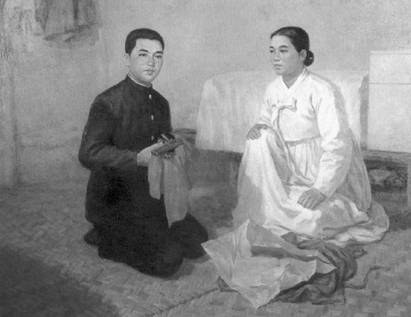
The Leader receives the weapons from his mother
What does the
Leader's relation to socialism look like now? Kim II-sung grew up in a
nationality-conscious family where the liberation of the country aroused
more nationalist than socialist ideas. Obviously there was no connection
with the "Group for the Study of Marxism," founded in 1919 in Korea, and
which published the Communist Manifesto. Neither did his family
maintain any contacts with the Communist Party of Korea, founded in
1925. Therefore, in this point the official biography shows signs of
having been dealt with touchingly. It has Kim Il-Sung in 1926, at the
age of fourteen, founding “Down with Imperialism,” the first
Marxist-Leninist organization in Manchuria, with the aim of "building
socialism and communism in Korea." At the same time, when fourteen years
of age he is said to have already overcome “the infantile disease of the
left and right of communism," although he had not become acquainted in
with the Communist Manifesto, Das Kapital and other
classics of Marxism-Leninism before 1927, when at fifteen years of age
he entered the middle school of Kirin, Manchuria. Consequently, early
Communist movements in Korea are officially disqualified: the Communist
Party, founded in 1925 is labeled a petit bourgeois, sectarian club of
intellectuals, although --as a consequence of industrialization through
the Japanese-- there already existed a workers' proletariat, which had
organized a few important demonstrations and strikes, and possibly had
been a basis for the Communist Party. In contrast, poor farmers, who
still partially engaged in slash and burn farming, almost exclusively
inhabited the border areas in Manchuria. The official biography states
then --already anticipating the future Leader: "In 1928 the Communist
Party was declared unlawful by the Japanese authorities in Korea; it was
not unified and had not overcome factional strife because it lacked an
outstanding Leader. Now the Korean people were waiting for their
outstanding Leader, Kim Il-Sung, who was already carrying the successful
way of the revolution within himself."

Kim Il Sung as a guerrilla-captain
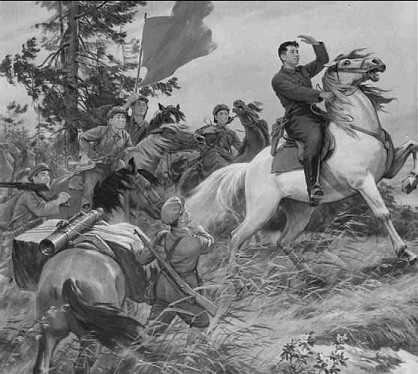
Kim Il Sung as a red Napoleon
In 1929, at the age
of seventeen, Kim Il-Sung was thrown into prison at Kirin because of his
anti-Japanese activities. In 1930 he was released. After that he is said
to have analyzed the political situation and to have developed the idea
of Ju-tse. Ju-tse is the formula with which Kim Il-Sung is
said to have further creatively developed Marxism-Leninism. People say
that he had adapted Marxism-Leninism to the Korean situation. Ju-tse
is a Korean word meaning something like sovereignty, self-reliance or
simply "create with one's own strength." On July 1, 1969, Kim Il-Sung
himself answered the question posed to him by the general director of
the VAR Publishing Company, Dar-al Tachrir, what he understood by
Ju-tse:
We carry out the Korean revolution. The Korean people, more than anybody
else, are acquainted with the Korean revolution. The masters of the
Korean Revolution are the Korean people, and the decisive factor of the
victory of the Korean Revolution is our own strength. With reference to
the Korean revolution, no foreigner has the right to give us a
prescription about how to act in this and that case, and no foreigner
can carry out the Korean Revolution for us. To carry out the Korean
Revolution successfully the masters themselves, the Koreans, must think
wisely, and in the spirit of the Korean Revolution solve all the
pertinent problems with their own strength.
Incidentally, this
formula was repeatedly conjured up with special vehemence at those times
when their own strength was not sufficient to solve a problem: for
example in 1945, when the Japanese troops were defeated by the allied
forces, or in 1950, when the Korean War would have ended in utter defeat
for North Korea without intervention by China.
The ideology of
Ju-tse corresponds approximately to the Stalinist formula, according
to which the culture has to be nationalist in form and socialist in
essence. Kim Il-Sung obviously took over from Stalin this contradictory
formula, which later became the basis for the ideology of the national
revolution, and then passed it off as his own product, as the miraculous
formula, Ju-tse. Ju-tse in North Korea today has come to
be in itself the anti-analytical, anti-enlightening sacrosanct word with
which all decisions by the Leadership are justified. When “according to
the idea of Ju-tse” is uttered, it means that the Leader has, in
his sovereign power, made a decision for the people.
The Leader, it is
true, does not exercise his power directly, but rather indirectly
through a hierarchy of functionaries who are, to a certain extent,
representatives of the Leader, or sub-Leaders. It becomes clear through
certain linguistic usages that this hierarchy is closely related to
traditional Korean despotism. In the People's Republic of Korea there
are two expressions for the word "comrade": the one expression is a
Sino- Korean word pronounced "dong-ji”; the other is "dong-mu," and is a
purely Korean word. Both can be translated as "friend." As the upper
layer in traditional Korean society used Chinese words in written and
spoken language, the Sino-Korean expression "dong-ji" is the more
refined and polite one, and is used when addressing people in a higher
position. So the worker addresses the director of the company with
dong-ji, while the other way around it is dong-mu that is
used. The usage of these words illustrates the hierarchical structure.
It reaches even into the family circle, where the husband uses
dong-mu to his wife while she addresses him as dong-ji. The
specific usage of the words dong-ji and dong- mu, meaning
"comrade," already points to the hierarchical character of North Korean
society.
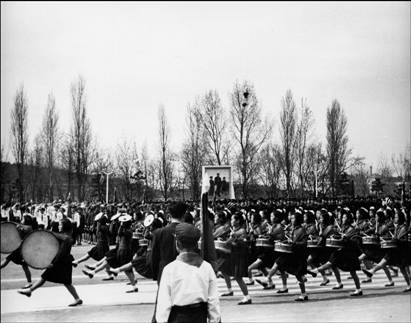
Young pioneers during the feast at Mangyongdae
Furthermore, the
functionaries’ fear of contact with the people makes this hierarchy
visible. They move about only in official cars for functionaries. If
children or idle lookers-on get too close they are chased away by the
driver. The functionaries have theater entrances of their own and make
purchases in special shops, where otherwise only foreign diplomats are
admitted. They talk to the people like a military commander to a
private. The pictures, too, showing Kim Il-Sung among workers, farmers,
or children, only emphasize that he really is not one of the people but
in fact stands high above them; but he condescends because he is the
good father who has taken his children's concerns to heart.
Now on the 15th
of April, all over the country the people celebrated his birthday in
events to show him their gratitude. In the afternoon of that day the
initiation of 1,000 young "Pioneers" took place on the square in front
of the "School of the Revolution" at Mangyongdae. There was a big
ceremony with many spectators present. (This "School of the Revolution"
being equivalent to a military school, was built for war-orphans, who
are being trained to become revolutionaries according to the spirit of
their new father, Kim Il-Sung.) At this initiation ceremony the
eight-year-old boys pledged to do their duty as Pioneers. When this was
finished, the various groups of Pioneers performed symbolically, by way
of mass games, the heroic epos of the Leader and of the party. These are
impressive, and not only for the foreigners. Their games, which
illustrate the national myth, are immediately recognized by even the
youngest, but they function to suppress the individual (if we may apply
this conception to North Korea) development of the imagination even in
the bud.
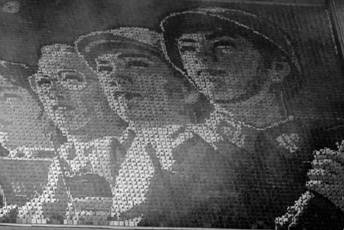
Mass games picture
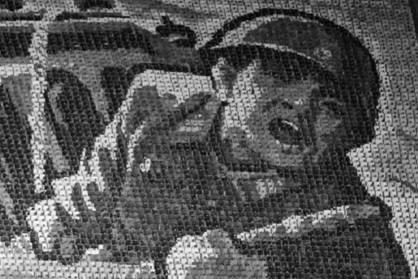
Technically these
tableaus are produced thus: Let us say we have 100,000 participants. The
tableaus to be presented will be put together in dots, similar to the
pictures on a TV screen or wire photo; each actor is given a book of
colored pages bound in the sequence of the pictures to be formed. All
that the actors have to do to produce a new picture is to turn a page on
command. Officially these mass games are praised as a new form of
folk-art, although they represent one of the most perfect forms of art
destruction. The character and intention of these games become perfectly
clear through a story that is told to the visitor, mainly to underline
their uniqueness. It goes like this: Sukarno, when years back he was
still president, wanted to introduce these mass games into Indonesia and
had, especially for this purpose, asked for advisors from Pyongyang. The
experiment ended in failure, however, as the Indonesians are not as
disciplined as the Koreans.
Mass
games picture
On the evening of
April 15th, a public festival took place on he Kim Il-Sung
Plaza in Pyongyang in honor of the Leader. The whole city, as always on
feast days, was aglitter in neon lights and looked like a provincial
town in the American Midwest, only that the lights were not advertising
Coca Cola, Ohio Popcorn or Kentucky Fried Chicken
but rather the symbols of the national revolution. The students of Kim
Il-Sung University recited poems and performed songs to the Leader,
transmitted with echo-effect by means of large loudspeaker-trucks. A
huge choir, standing in front of a gigantic illuminated portrait of the
Leader at the head of the plaza, also presented parts of the heroic
epos. To and fro flitted over it streams of bluish light from army
spotlights, bathing the scene in a mysterious, mystic atmosphere.
Lengthwise along the square, colossal portraits of Marx and Lenin in
wide, baroque frames had been hung on the front of a building, and on
the opposite side, in lighter tints, another picture of the Leader.

Glory and gratitude to the Leader